It was a normal August evening and I had just sat down to watch the evening news when I noticed something weird – no signal from my favorite local broadcaster, Global BC. No matter, I thought, Sometimes the over-the-air feed into the datacenter where I have my tuning equipment can be a little flaky due to a mountain in the signal path, I could switch to the yagi antenna on the roof of my house which has more gain and a better line of sight and generally works great.
A few clicks later and I had a signal… sort of. While the channel was there it was pixelated and broken, symptoms of a weak signal. Confused, I checked a few of the other Vancouver TV broadcasters: CBUT? Check, CIVT? Check, even the much weaker CHNU? Coming in just fine. I wrote it off as some kind of issue with Global’s transmitter and figured it would be resolved in a few days.
I switched to an IP feed of Global for a while, and almost forgot about my over the air issues, except for the fact that IP feeds are so much less reliable then broadcast television, and while trying to watch the news about a week later I found myself in a state of constant buffering. Time to switch back to the over the air feed, they must have fixed it by now right? Nope. Same issue, no signal at the datacenter and a garbaled signal at home. Hmm… something must be afoot.
My next course of action was to head on over to the trusty DigitalHome forum – A discussion board I’ve been active on since high school where people gather to discuss reception reports of various over the air broadcasts. The forum came through, but the news was not good! Someone posted a link to a CRTC application by CHAN-DT to move to a new tower at a lower height, over 300m lower then their old position – this must be the reason for my reception issues!
I ran some plots and determined root cause – a chunk of rock between me and the new transmitter. With the transmitter at 600m I had a clear line of sight, but with the transmitter lowered to around 300m I no longer had a clean line of sight to the tower; the signal was now too weak or too distorted for my tuner to make a decent lock. It appeared that I was out of luck.
At this point most people would give up and just resign themselves to using the Internet to receive their programming, but not me! When it comes to radio signals I don’t give up easily.
I tried raising my antenna a bit higher – insignificant improvement, then I started researching other antenna options; I already had a pretty huge yagi (over 6ft long) but was there something I could buy that would give me even more gain. The massive Televes DATBOSS which should net me more gain, but that antenna is expensive, and I worried that my problem wasn’t purely related to signal strength, that I could be suffering from multipath

Multipath is a situation that occurs when an object (such as a mountain or building) sits between the receiver and transmitter. When RF signals encounter such an object they bounce and change direction, and if the original signal and the bounced signal both arrive at the receiver this can cause reception issues. In the analogue days this would create ghost images on the TV, but with digital signals the tuner tends to just loose reception entirely. If this was the case a larger, more badass antenna might not even help me!
As I pondered just how to determine if my situation was weak signal or multipath, life would throw a bit of good fortune my way.
I had been doing a lot of work with the Saanich Emergency Program, which has an amateur radio communications group that operates a couple of repeaters in addition to staffing the radio room for the municipal government. Helping out with the program had given me access to one of their repeater sites in the past as we had installed a HamWAN node onto it, and I began to consider the viability of this site as an answer to my TV reception woes!
First, some background. This site sits at about 150m elevation and had two 5GHz links installed the previous year – one to the very datacenter which housed my TV tuner, and the other to the rest of the HamWAN network. I ran some plots and the site had a theoretical clean line of sight to the CHAN-DT transmitter on Mt Seymour; even at it’s new, lower location. I obtained the necessary permissions to install an additional antenna and took a quick drive up to the site with a laptop in order to conduct a preliminary test. With the antenna in the car, I got 90% signal… good enough for me!
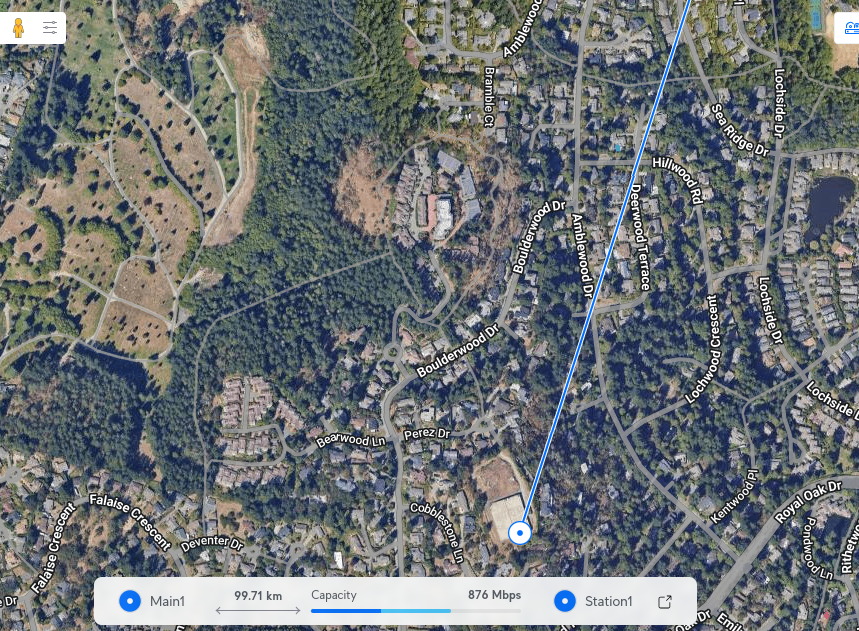
I spent the next few weeks putting together a plan and an equipment list. I’d need about 200ft of coax from the antenna into the radio room, I’d need an amplifier to handle the signal loss over such a long run of coax, then of course the antenna and the tuner. Some miscellaneous hardware such as connectors and couplers rounded out my BOM. Next came the hardest part – waiting to schedule the installation.
It was a few months later, but finally everyone’s availability aligned and a date was set. There were a few false starts, some challenges getting the antenna actually mounted to the tower, and at least one cancelled work party, but finally on a sunny Saturday in April my new antenna was hoisted into position, and I found myself scanning for signals using TVHeadend!
Initial results were promising; 100% signal on CHAN-DT, and mid-90’s on the other Vancouver broadcasters. We buttoned up the shack and I headed home to start configuring things.
I had opted to use a networked tuner called the HDHomeRun. This small device has 4 tuners internally, and exposes them over a network where client applications, such as TVHeadend, can access for ingesting programming. My initial plan was to expose the tuner directly to my TVHeadend instance at the datacenter, but I quickly ran into an issue – glitches and artifacts in the video stream.
As best I could tell, despite the 5GHz wireless link into the site having a high capacity (testing at more then 70mbps) the 20mbps raw transport stream coming off the tuner was too sensitive to jitter and the wireless link just wasn’t reliable enough for the raw feed. No matter, I had installed a mini-PC at the site in case I needed to pre-process the feeds into a more Internet-friendly format.
I experimented with a few different methods, but eventually found that the most reliable approach was to run ffmpeg in a loop and chop the input stream into HLS chunks. On the other end, I was able to configure an IPTV source and point it to the m3u8 file. Everything seemed to work fine for the first few days, but then I began encountering problems again (I was used to it by now)! Time to put on my debugging hat again.
The symptoms this time were a little different – my signal quality was solid; mostly 100%, except for very occasional dropouts which corresponded to artifacts in the video or audio. I suspected some kind of local interference, though even the addition of a band-pass filter didn’t seem to help.
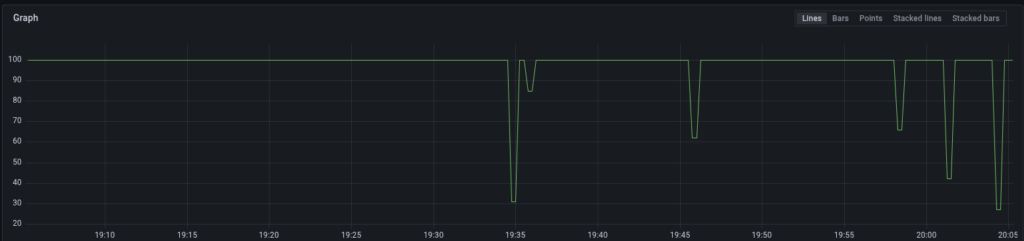
After some troubleshooting, I engaged the vendor support and was pleasantly surprised! Not only were they responsive, but they were extremely helpful at analyzing the debug logs and came to an unexpected conclusion – my signals were TOO strong!
According to the support team, what I was experiencing wasn’t the result of interference, it was simply that some of the stations my antenna was receiving (KVOS, I’m looking at you!) were overloading the frontend of the receiver. My amplifier to compensate for my excessively long cable run was actually hurting me!
So now I’ve arrived at my current predicament – I’ve ordered some attenuators which can be installed in-line before the tuner in order to bring the signal levels down to a more manageable level – I just hope I won’t sacrifice too much signal on CHAN-DT while doing it!
While I don’t yet have a flawless signal, I’m still at least getting a functional feed, and the buffering from using an internet source is over which is an improvement over where things were a year ago. I hope Global is saving a lot of money from their new transmitter location, because it’s sure caused me a royal pain in the ass!