This is the second installment of a series of blog posts about my 2026 trip to Taiwan. I’ve tagged them all with the taiwan tag so they should be easy to find!
I had left Victoria on a Saturday night, but because of the time change and the duration of the flight it was Monday morning before I landed in Taipei, and mid-morning by the time I arrived in Kaohsiung. Because I had left late at night, and because it was now morning, and because I had slept for some hours on the plane, I actually didn’t experience any jetlag on this part of the trip. Don’t get me wrong, I was tired, but nothing that a solid night’s sleep couldn’t fix!
After leaving the train, my first experience was the 7-11 at the train station, which my Girlfriend insisted I visit. Not thinking much of it, I popped inside and was immediately blown away by how much different they are then the 7-11’s back home. While 7-11 in Canada is known for slurpees and maybe a hot dog, in Taiwan 7-11 carries everything; from a small selection of fresh fruits, to all manner of hot meals, to more kinds of pre-packaged foods then I could ever have imagined, all crammed into roughly the same tiny square footage that it would occupy back home! 7-11 is also the go-to place in order to to up your EasyCard, and will even allow you to pay some traffic fines! It’s a big deal in Taiwan, and there is one on nearly every street corner!
My visit to 7-11 completed, we headed out to her mom’s car to be driven back to the family home, and I got my first real taste of Kaohsiung.
Driving through the streets of the city, I was immediately struck by how visually loud it was. Large, colourful signage adorned every business and many of them sported flashing lights as well. There was a lot to process, and the scene looked to me like the classic stereotype of an Asian city as portrayed in movies and TV shows. I guess stereotypes originate from someplace. Our drive to the family home only took about 20 minutes, and it wasn’t long before I was introduced to what I’m told is a fairly typical Taiwanese home.
Their house is one of a number of rowhouses, smashed together in small groups of three. The hoses are narrow, roughly 13 ft wide, but reasonably deep and three stories high. The layout inside is fairly efficient, with a living room space located immediately off the front entrance, which leads to a dining table, and kitchen and bathroom beyond that. Stairs (steep!) lead to the upper levels on the right hand side, just beyond the table. The entire space is an open concept and makes efficient use of space.
The second level houses the parent’s bedroom, along with another den-type space, along with a sink, a space to dry laundry and another bathroom. A balcony beyond that is where the washing machine is located.
Another set of stairs brings you to the kids rooms with my girlfriend’s childhood room located on the back half of the floor, and her brother’s room on the front. A third bathroom is located off my girlfriend’s room, and both sides of the floor have a balcony. Overall, they made very efficient use of space, and even though it was quite small, I never felt cramped, and having a bathroom on every floor was super convenient – with as many bathroom as there were people, there was never a wait to use one!
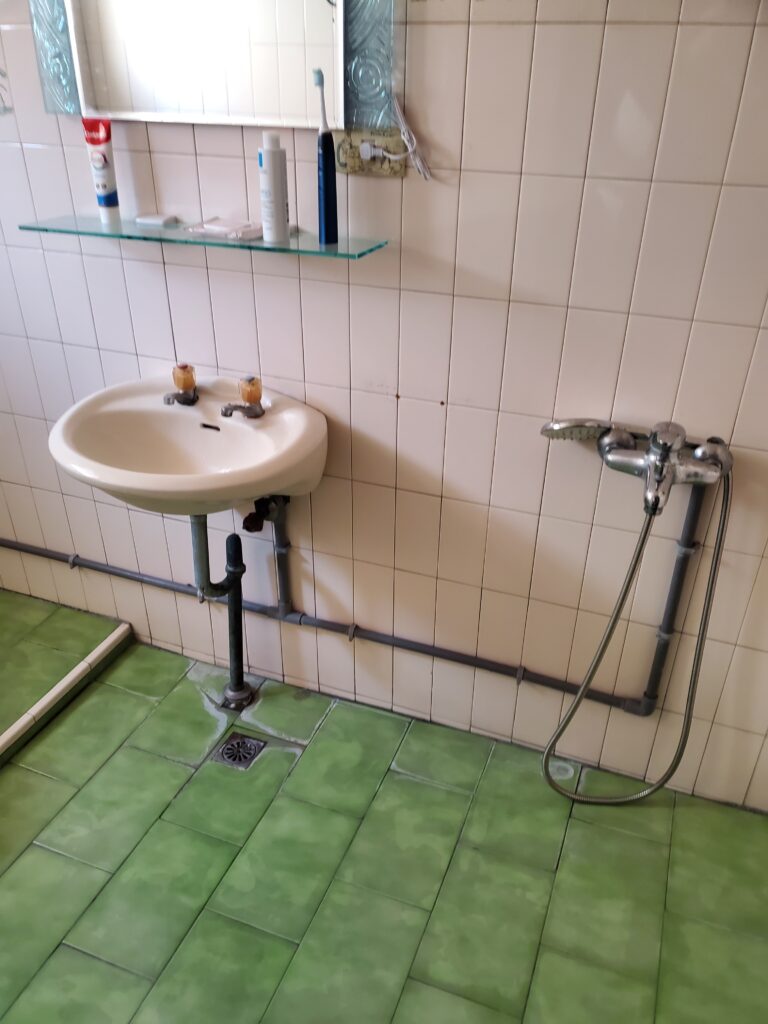
The bathrooms themselves are an interesting design – with the shower, sink and toilet sharing one open space. When you have a shower, the whole room gets wet, though a drain makes sure residual water leaves fairly quickly. The concept is called a “wet room” and I’d only ever experienced it once before at a hotel in Copenhagen. I thought I would hate it more, but I adjusted, and even though it was annoying to have to walk through puddles to get to the toilet if someone had just taken a shower (flipflops are useful here!) I adjusted, and I’ll admit it makes things easy to clean and is a much more efficient use of space then a traditional bathroom with a tub or partitioned shower. I’m told this design is quite common for bathrooms in Taiwan.
The Department Store
Shopping in Taiwan is extremely popular, and I was surprised at the number of department stores, including ones dedicated to higher end brands, around Kaohsiung. Granted, it’s a city with over 2.5 million people, but I definitely feel the density of department stores here is higher then other places.
While in Taiwan, do as the Taiwanese do and shop! We spent a good chunk of the day visiting the department store Mega – all twelve floors of it – and even discovered a great little food court on one of the upper floors where we stopped for lunch at a delicious Japanese restaurant that had a great view of the city.
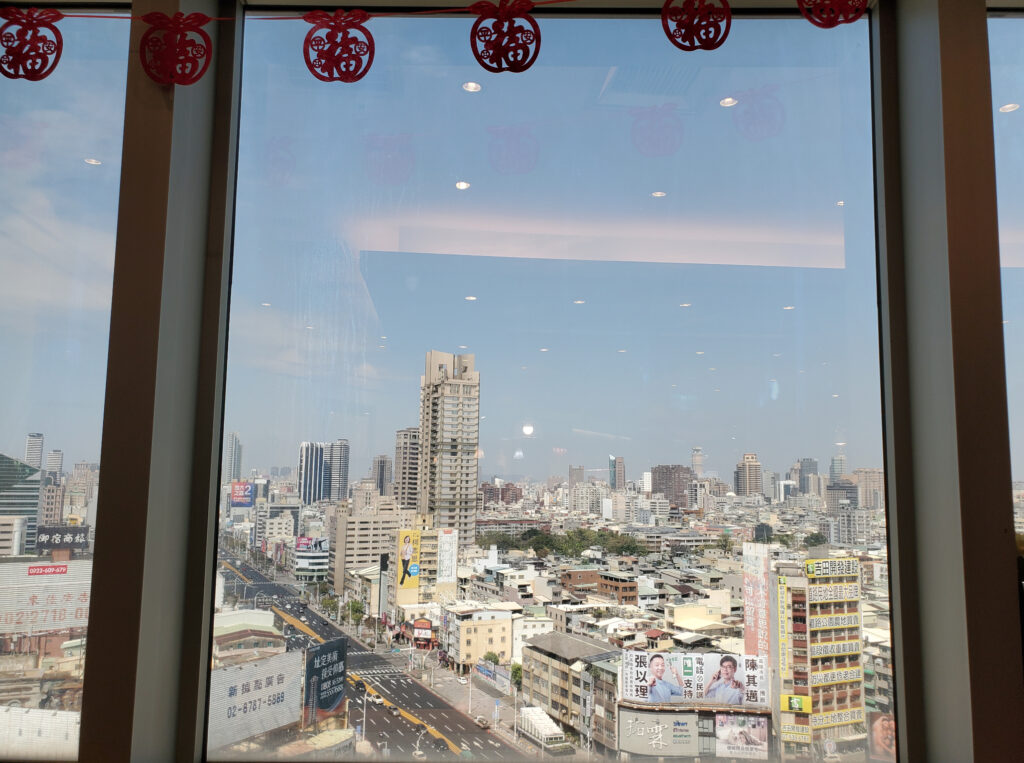
As we continued our way up, I discovered just how massive this store was! Not only did it have shopping and food but also several floors of movie theaters and even an arcade!
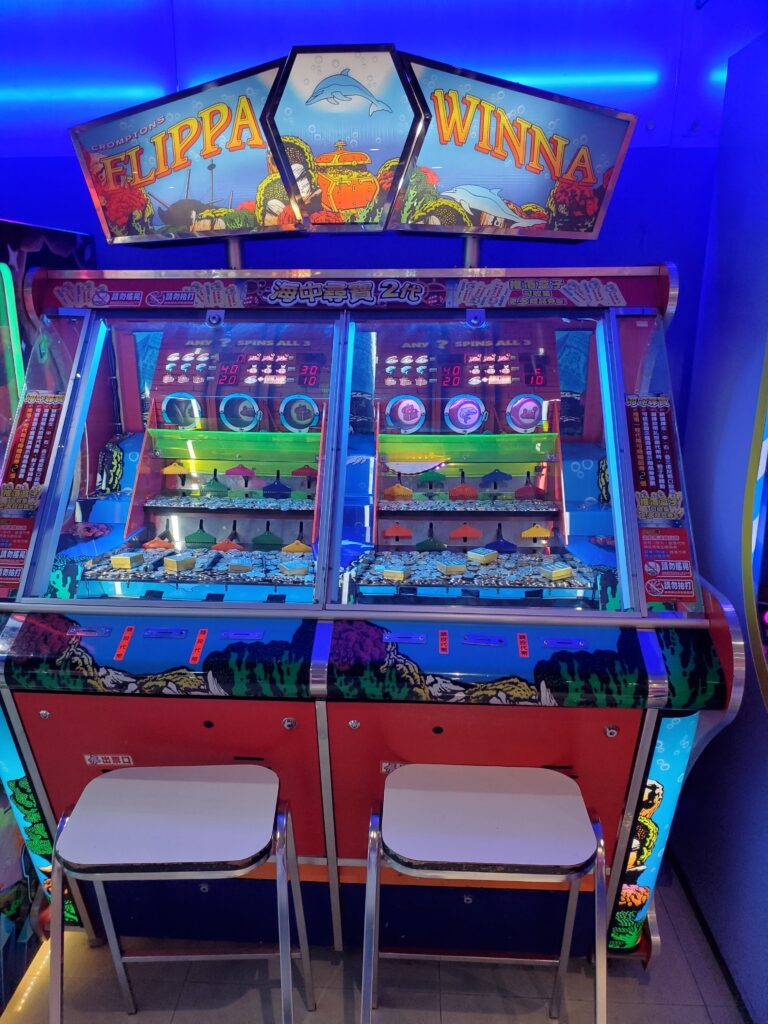
The arcade was another point of interest for me. Like arcades back home, you purchase tokens which operate the machines, and also like home they had the classics like shooting games, basketball games and even air hockey, but something stood out to me – the number of machines that just seemed to be gambling!
There were a wide variety of coin pushers; where you drop a token into the machine and hope it lands in such a way where it pushes a bunch of other coins down. There were a few machines where tokens drop into piles and you hope the pile falls over, and others similar to pinball, except that you really have no control over where the ball falls, and you need to hope that it lands on a winning spot. All of these games have one common theme – they’re all based on chance, rather then skill, and if you win you get a pile of tickets that can be redeemed for prizes. We played a few rounds and, like gambling, it was fun but I wonder if people get hooked on these games like they can gambling, or if it even acts as a gateway to higher stakes gambling in a casino.
The Night Markets
Every time I looked up what to do in Taiwan the common theme was to visit a night market, and after visiting several I can concur – the night markets in Taiwan are insane! The largest is Kaohsiung is the Rueifong night market which, according to official documentation, contains over a thousand stalls. While I didn’t count, I can attest that the market is huge spanning more then 5,000 square meters! The space is divided into rows and alleys and as far as the eye can see there are stalls jammed up against each other where you can buy… pretty much anything! It was sensory overload with the sights, smells and sounds almost too much for me to absorb at once. For someone used to sitting on a computer and focusing on a single task it was a huge change of pace.
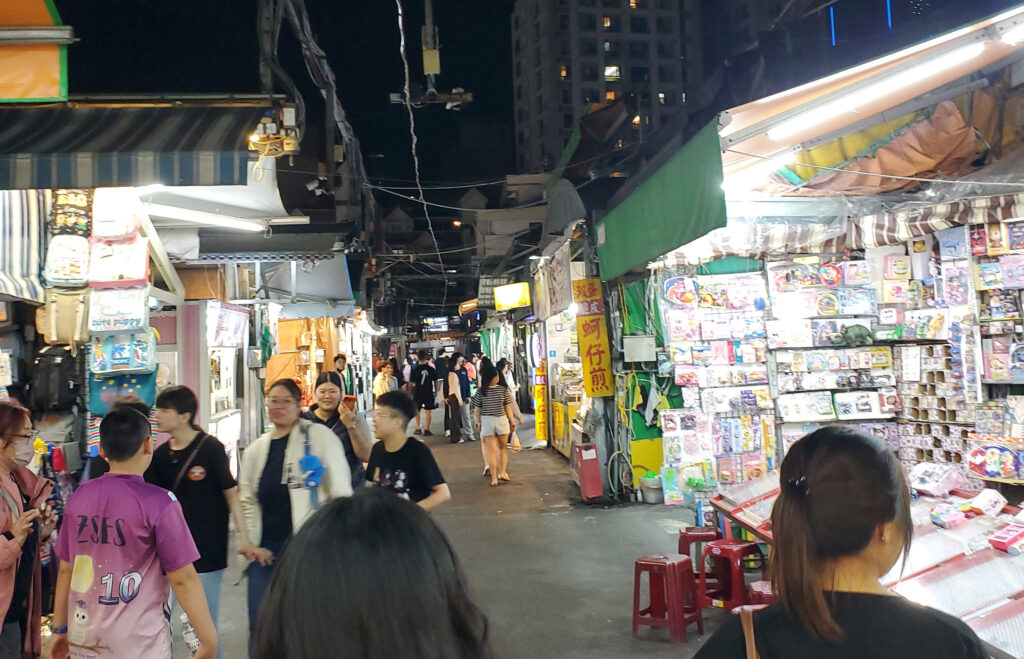
A big draw to the night markets is for food, in fact I would estimate that roughly half the stands are selling food or snacks and it’s possible to get just about every kind of food imaginable if you look hard enough! From steak on a plate to squid on a stick, if you can imagine it it’s probably available for purchase at Rueifong. It is, of course, almost exclusively cash-only, and the prices for most of the food
The atmosphere is also electric; almost like a carnival vibe. With the lights, the music, the people bustling and just so many things to look at, it’s possible to loose yourself in the experience and hours slipped by like they were nothing!
In addition to the food, and the shopping there are also games galore. There are the classic carnival type games like the ring toss, the shooting games and tub toss, but there also also more gambling-style arcade machines which pay out tickets – including pachinko in which you load metal ball bearings into a machine and hope that they land in such a way where you win more ball bearings. I’ll admit to not really understanding how it works; maybe I was just lucky but I kept winning more ball bearings – until I had more then twice what I had started with – but I didn’t really know what to do with them. After about 10 minutes of this I’d grown tired of it and donated my ball bearings to a very appreciative couple who seemed to know more of what they were doing then I!
In the same stall as the pachinko machines there were more claw machines then I had ever seen before in my life. I was used to amusement parks where one, two or maybe a half dozen claw machines would be spread about, but this was another level! Claw machines as far as the eye could see, and selling way more then just the usual stuffed animals too. My girlfriend became fixated on winning stuffed fries and before the end of the night we had a half dozen and counting!
Monkey Mountain
Something that I didn’t plan on seeing while in Kaohsiung was a mountain full of monkeys, but that’s exactly what I got early one morning when I was invited on a hike.
Monkey Mountain is part of the Shoushan nature preserve, a 500 hectare park just on the periphery of the city. The area has an abundance of walking trails and is popular among locals for recreation. It is also home to a large population of Formosan rock macaques – or as my girlfriend refers to them “bratty monkeys.” The macaques are infamous in Kaohsiung for being a pestilence for all who hike the trails of Shoushan – if you’re not paying attention they’ll sneak up and steal your stuff! While hiking, nearly everyone we encountered had some kind of a stick – something that my girlfriend assured me was to deter the monkeys!
The hike up the mountain was a good one, and I was definitely out of breath by the time I reached the top, but I was rewarded with a fabulous view of the Kaohsiung skyline. The mountain definitely lived up to it’s name since the paths and trees were literally crawling with macaques. I’ve never seen so many monkeys in one place before!
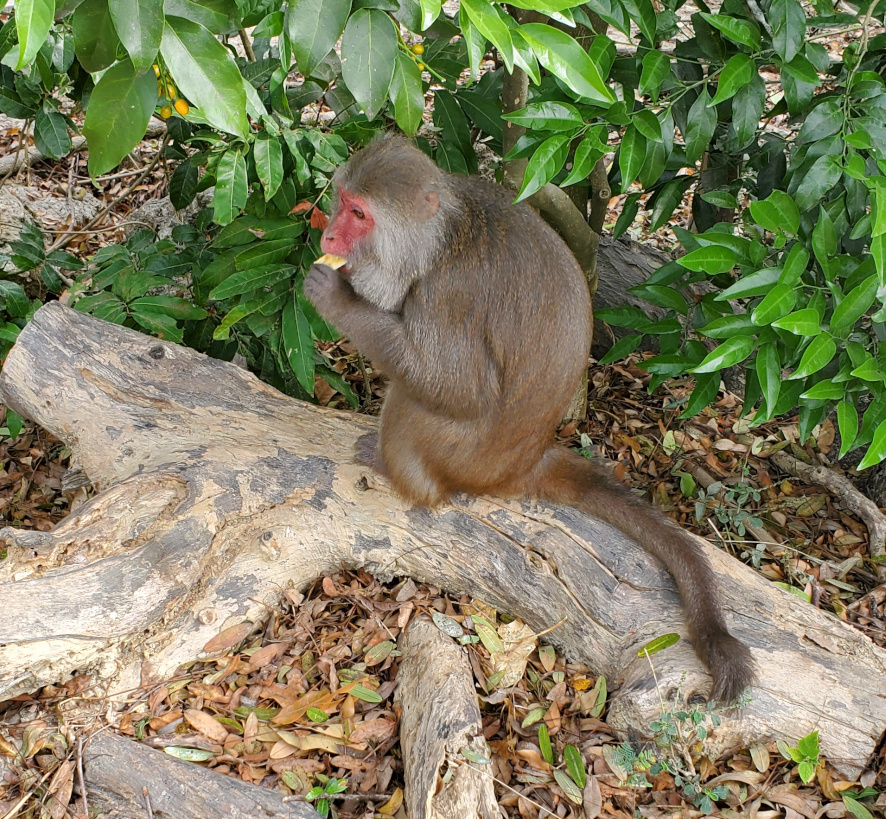
I’m told that the monkeys were exhibiting unusually good behavior during my visit – we weren’t attacked or approached once which, apparently, is rare. I was even regaled by one story of a particularly cheeky monkey jumping onto the back of someone while they were riding their scooter, rummaging through their bag, stealing their lunch and jumping off, all while the scooter was in motion!
I’m truly glad I had a chance to visit Monkey Mountain, both for the hike, and for the opportunity to see these “bratty monkeys” in person!
Cijin Island
When looking up “things to do in Kaohsiung” one of the recurring suggestions, so of course it made it onto the list! Cijin is accessed by either ferry or vehicle tunnel, so as pedestrians we took the ferry. The boat runs every 15 minutes and you pay using your EasyCard, which is super convenient. The journey itself is described as one of the shortest ferry rides in the world, and that is very true; after less then 5 minutes our boat was already docking on the other side!
It’s popular to rent a bike and cycle around the island, and immediately upon disembarking we were greeted by a number of vendors offering all manner of bicycles to rent. In fact, the entire main road to the ferry terminal is lined with vendors, restaurants and food stalls all vying for business from visitors disembarking the ferry. It felt similar to the night markets I had visited the previous nights. As we walked along, I even spied more claw machines – at least two rooms of them! I guess the claw machine craze had spread to the island as well. We took a walk up to the end of the main drag and back to the ferry terminal to check out the stalls and bought some boiled quale eggs on a stick – they were pretty good!
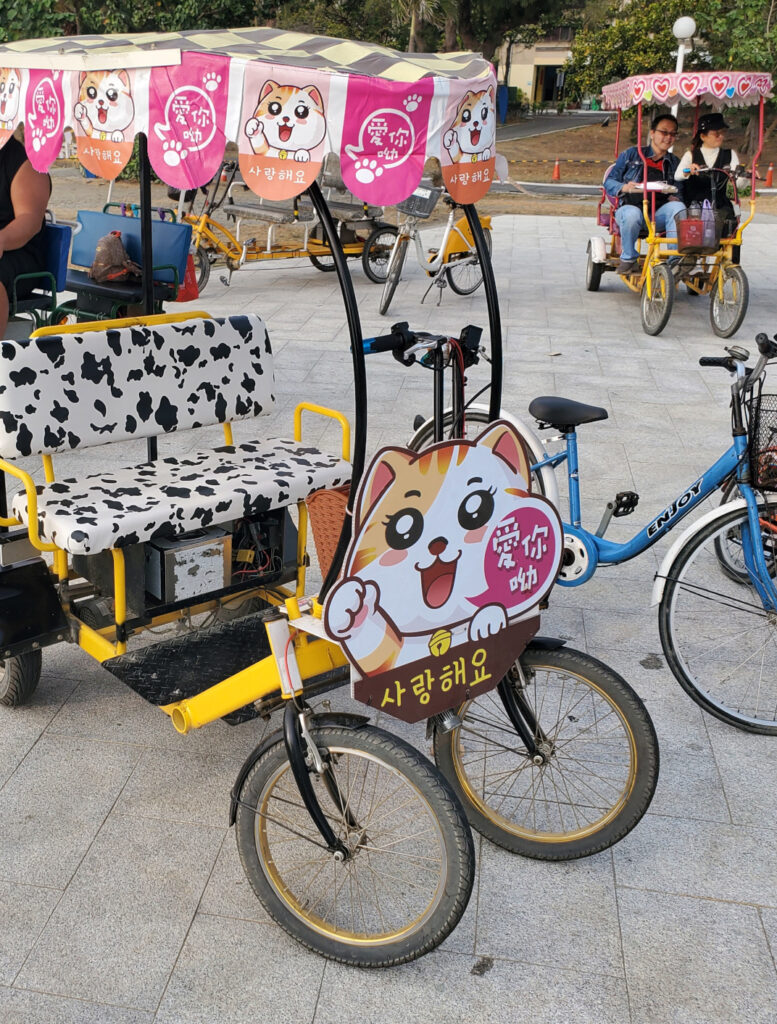
Back at the dock, we decided to rent an electric rickshaw to explore the rest of the island.
The rickshaw we rented really spoke to the ingenuity of the street vendors. While it was originally built as a pedal contraption, the guys had modified it to have an electric motor, handlebar controls and a beefy 48V battery. I spied some modified arc-welders which were likely used to charge the vehicles when returned. The whole thing looked like something I would have cobbled together as a child in my basement, but it felt solid enough and we were soon on our way – zipping around the island at some 30km/h.
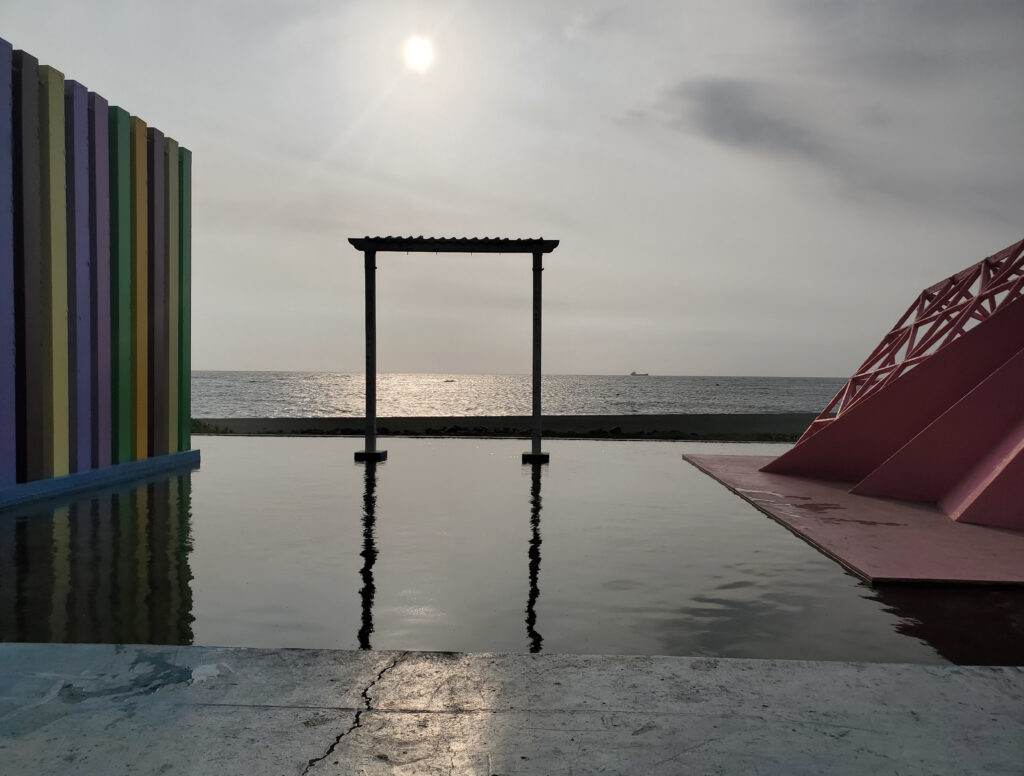
Once you get away from the main market street near the ferry terminal the natural beauty of Cijin island really begins to show through. As we drove along the bicycle path there was beach and open ocean to our right, and palm trees and vegetation to our left. I could have easily have been transported to somewhere in the Caribbean!
Capitalising on the natural beauty, there are also a number of photogenic art installations, such as the ‘rainbow church’ and an outdoor amphitheatre. The island is also home to a wind turbine installation which, according to documentation is supposed to provide the park with power to run the lighting, though on my trip the installation seemed to be in a more dilapidated state.
By 4:30 we had to return the rickshaw, but there was still more to see on the island, a lighthouse and a tunnel!
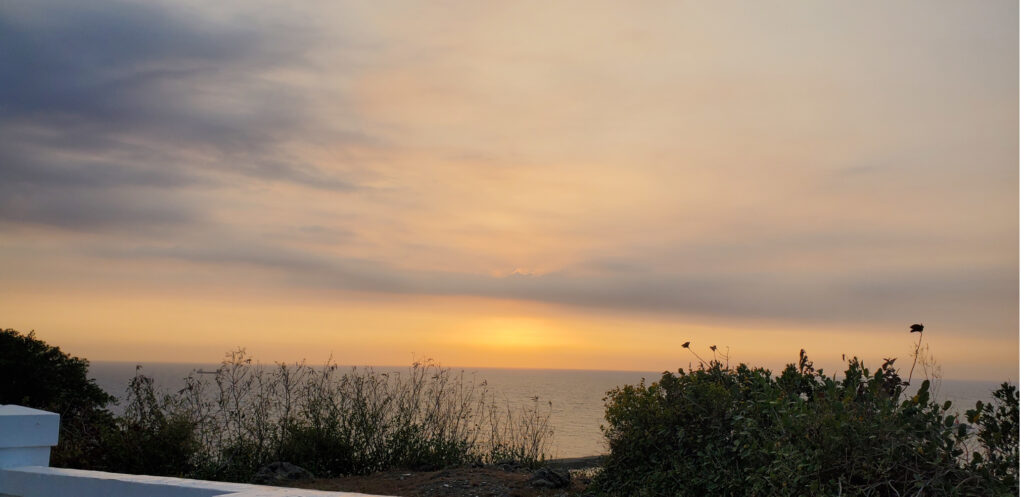
The Cijin lighthouse was originally constructed in the 1800’s to mark the entrance to Kaohsiung harbour and in 1985 it was designed an historical site and has become a popular tourist attraction. You get to the lighthouse by climbing a series of steps… a lot of them! But once at the top the reward is some spectacular panoramic views of the island, the city and the coast. There is even a little cafe at the top where you can purchase drinks to refresh you from the climb up! We found it to be a spectacular place to watch the sunset from.
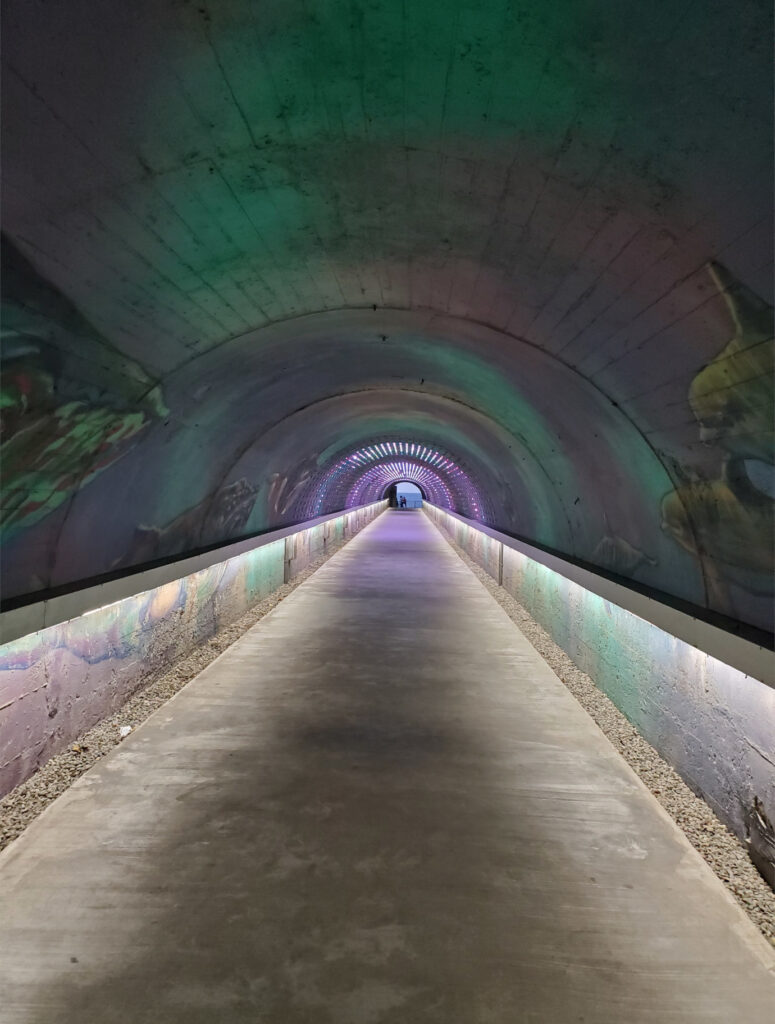
Finally, it wouldn’t be a Chris trip if there wasn’t some kind of underground excursion involving a tunnel! Cijin Island was host to a military battery, built by the Japanese in 1875 but has since been abandoned. The battery itself is mostly dilapidated, but a tunnel which was part of the base, was retrofitted with murals and LED lights and has become a popular tourist attraction. On the other side of the tunnel, you find yourself face to face with the rugged coastline of Cihou Mountain. As I emerged from the tunnel, I found my face wet with the spray of the ocean waves crashing onto the rocks below me. It was a dramatic scene, almost like from a movie.
While I wouldn’t technically count it as urban exploration, the Cijin tunnel is a cool attraction, and it was fun to experience a tunnel I was supposed to be in, rather then one where I was technically committing trespass!
The Lotus Pond
Another highly recommended thing to do when visiting Kaohsiung is to visit the Lotus Pond – a man made lake featuring a walking trail, green spaces and a number of temples on the water. The pond was built in 1951 in an attempt to boost tourism in the city, and it certainly seemed to have worked! The was one of the few areas in Kaohsiung where I actually encountered other foreigners.
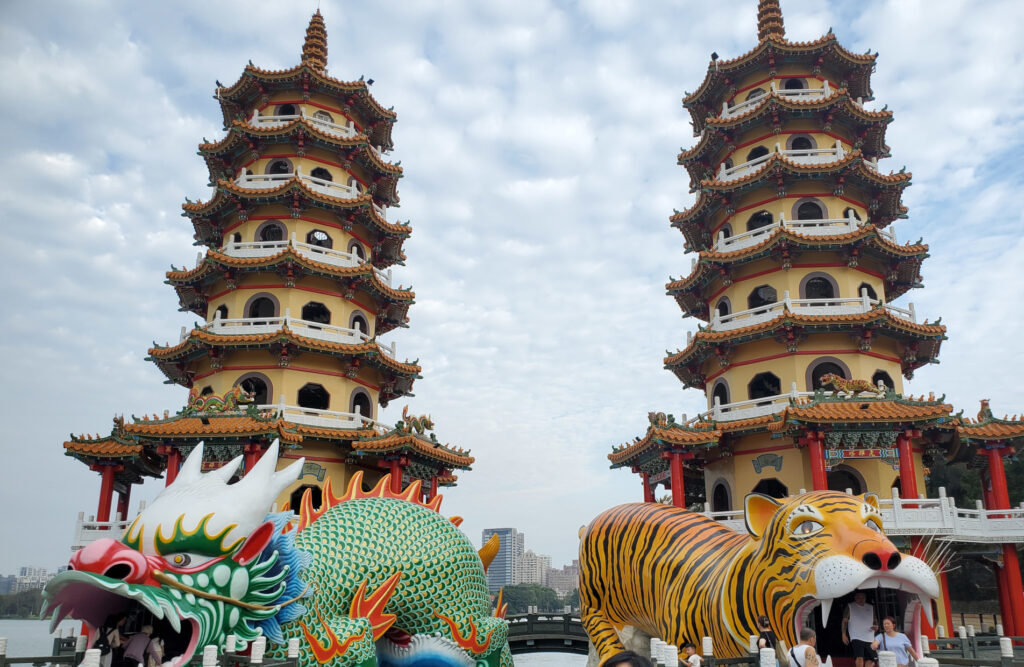
For a man-made lake, I was actually quite impressed at the size! I was expecting a small little pond, but what I found was a lake more then 200m wide and over 1km long! The pond is best known for it’s statues of a dragon and tiger which you can walk inside. For good luck, superstition has it that you enter through the dragon’s mouth and leave through the tiger, and I was sure to do that “just in case!”
Behind each statue is a tower that you can climb to the top of if you’re so inclined. While not as many steps as with the Cijin lighthouse, it was still a lot of steps!
While I had expected to see the famed tiger and dragon, what I didn’t expect to find were temple’s on the water, but that’s exactly what I found – two of them in fact!
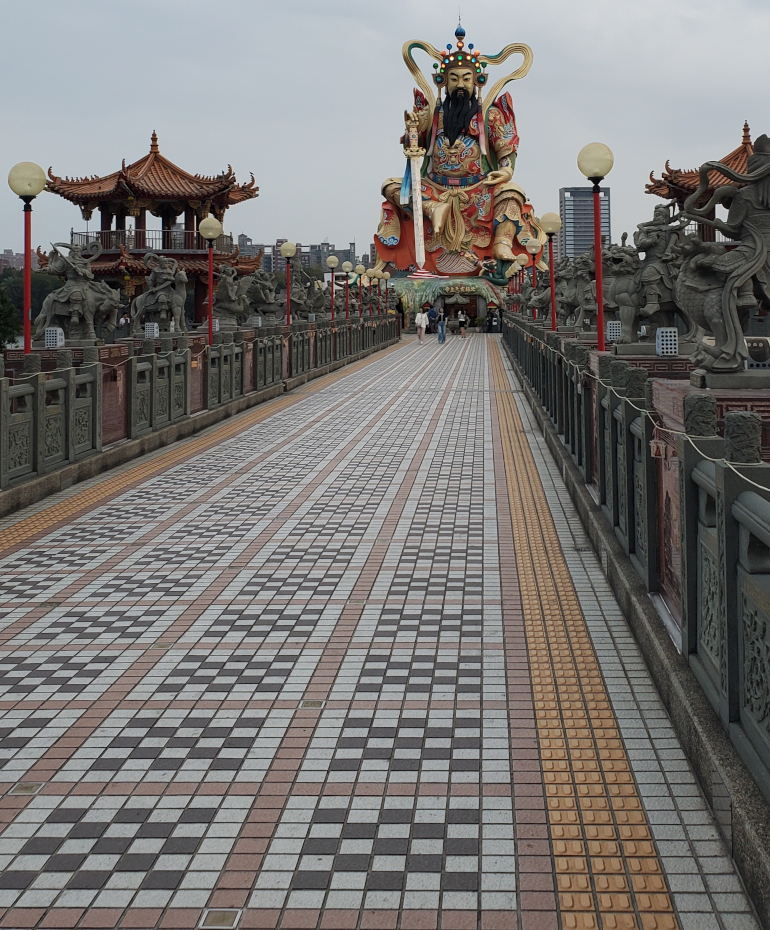
There is the the impressive 2 story tall floating Wuli Pavilion around 150 meters from the tiger and dragon, but by far the most impressive is the 72 meter tall statue of the deity Xuan Wu, with the actual space of worship is at the base of the statue, and it’s possible to enter and climb up inside! This temple also has an island that serves as a sort of bird sanctuary – where a number of birds, all suffering from a variety of different conditions, are cared for by the staff of the temple.
There is also a number of fish (I think they are a type of coy) that live, or at least congregate, near the Xuan Wu statue. The temple sells fish food, and we found it quiet enjoyable to spend some time feeding the fish over the railing. The birds also enjoyed the fish food, and there were mote then a few duck/dish scraps as we dropped pellets of food into the water below!
There is also a nice walking trail around the pond, interspersed with greenspace and all kinds of foliage. Everywhere you can find waterfowl such as a variety of ducks and geese. It’s a nice escape from the hustle and bustle of the massive city that surrounds it.
The Love River
Kaohsiung’s so-called Love River flows some 12 kilometers through the city and flows into the ocean not far from the Cijin lighthouse. The area surrounding the mouth of the river is a popular gathering spot, with street vendors lined up all along the riverbank.
The area is also home to the Kaohsiung Music Center, which in the evening puts on a spectacular light show I was lucky enough to catch. The building itself opened in 2021 and is architecturally very unique; being comprised of a series of hexagons all inter connected.
One popular attraction was a giant floating robot statue, which I am told, is the mascot for the city. The official name for him is ‘Ultraman,’ but my girlfriend informs me that he is more colloquially known as “salty duck egg superman” on account of the shape of his eyes! Whatever his name, he was certainly a popular attraction for people.
Kaohsiung, Honorable Mentions
There were so many things I did while in Kaohsiung that I would be typing for days if I was to try and include all of them, so I’ll try to summarize just a few more!
- The Sanfong temple is a huge sprawling temple in the center of the city that is a must visit. There are dozens of rooms, all with elaborate sculptures and paintings. At night, the whole temple lights up in a sea of red, as the lanterns suspended above the main courtyard come to life!
- The Dome of Light is a metro station that has been transformed into a beautiful mosaic of lights and images. It pops up as one of the major things to do in Kaohsiung, and while it’s cool to see, I wouldn’t make a special trip of it. If your in the neighborhood though, it’s definitely worth a peak
- Possibly one of more under-rated attractions is the Hamasen Museum of Taiwan Railway which dedicates an entire room to a model train set, devoted to displaying the many railways of Taiwan. The model is mostly to scale, and even has the trains running on a schedule! I was able to right away pick out some major landmarks, such as the Lotus pond and use that to trace some of the railways.
- The Hamasen Museum is located in the Pier 2 art district, which is a transformed industrial area with a focus on art and creative exhibits. My girlfriend and I also found the most random little shop that sold ice cream, beverages, socks and a variety of vintage items. This delightful little store served me the most refreshing iced matcha I’ve ever had in my life and had fantastic ice cream to boot
Overall, I enjoyed my time in Kaohsiung more then I thought I would. The juxtaposition of old temples and modern architecture, the vibrant night life, the eclectic mix of street vendors , the excellent transportation and all of it within a stone’s throw of a nature preserve really made me enjoy my time in Taiwan’s southern metropolis. While I don’t see myself living there, I definitely could see another visit in the near future.