Back around 2020 a new word began entering the vocabulary of radio nerds around the world – LoRaWAN, or Long Range WAN – a neat protocol which sends small amounts of data large distances using tiny amounts of power. As the years went along the technology kept improving and while I was aware of it, I was a busy person and hadn’t looked too deeply into the technology, despite being a self-professed radio nerd!
Fastforward to mid-2025 and I found myself dragged into a LoRa project when a friend needed me to make introductions to a tower site owner in order to install a LoRa repeater. The negotiations were successful, and I tagged along to witness the installation of a Meshtastic repeater on Triangle mountain – a well known radio site just West of Victoria.
I’ll admit to having a low expectation when it came to this technology. On paper it seemed a little hokey – with data rates of just 1070bps (56x slower then dialup), and since it used a meshing protocol where all nodes in range rebroadcast messages to all other nodes, I expected it to have major issues with message delivery and reliability, still my friend was excited about it, and I do tend to enjoy all things radio, so I decided to learn a bit more.
Which Mesh is Best Mesh?
The first thing to understand about LoRaWAN projects is that there is no one standard to rule them all. Way back in 2020, development started around a project called Meshtastic, which for a few years was the de-facto standard when it came to LoRa communications. Then, as things so often do in the radio world, the community fractured and new protocols emerged. The result? Different networks emerged, each with their own benefits and disadvantages, and development resources split between all of them. Every time something like this happens it reminds me of that age old XKCD about competing standards.

Humor aside, by 2026 the playing field for off-grid LoRa communications is pretty diverse, but there are two standards that stand out, having the most promise, and momentum – Meshtastic and Meshcore. They both cater to different use cases.
Meshtastic
Meshtastic is the original, O.G. LoRaWAN communications protocol started way back in 2020. It was built by Kevin Hester and has since garnered a large following of hobbyists, and their git repository sees contributions from a vast number of developers. It also has the widest adoption of any of the LoRa protocols. The original goal of Meshtastic was to enable communication between friends while participating in hobbies outside regular cellular coverage. Think about how nice it would be to text your buddies while out camping in the back country, far outside the range of any cell tower. The default settings prioritize range at the cost of channel congestion, since it was designed with the thought of being far away form other users.
Over time, the popularity of Meshtastic (and off-grid LoRa communication in general) began to increase and developers began adding more features to the firmware. By 2026, it is possible to text, but also setup encrypted group chats, exchange GPS co-ordinates, operate a weather station and even link meshes together over TCP/IP or the Internet. Because the developers are so open to new ideas the protocol is constantly being extended to support newer, cooler things.
Meshtastic has also become so popular that many cities have dozens or even hundreds of nodes. At first glance this seems like a great thing! More people to talk to, more nodes to relay your messages and more reliability for all! The reality though, is quite the opposite. The default settings in Meshtastic mean that every node will relay messages from every other node, which means that in a high density situation the channel simply becomes flooded with messages. This isn’t a surprising outcome, after all Meshtastic was designed with the idea of being used in the wilderness, far away from other users. The protocol, with it’s default settings, simply can’t handle the volume of traffic that you find in a city. Messages end up being delayed, lost, or sometimes duplicated and the end user experience can be quite frustrating. Attempts have been made to correct this, by adding newer radio settings which send less data, and pays more attention to channel congestion, but because there is already a critical mass of users, any breaking change is difficult, if not impossible to implement. The result is a network that has a lot of cool features, and mostly works, some of the time.
Meshcore
Frustrated with the shortcomings of Meshtastic, Scott Powell began developing MeshCore in late 2024, and by mid-2025 the first releases were available on their git repository. While it has fewer contributors then Meshtastic, Meshcore still has a lot of momentum behind it, and considering it’s almost 5 years younger then Meshtastic, the speed of adoption truly is impressive!
Meshcore was specifically designed to address the problems created by using Meshtastic in an urban environment. Meshcore only allows dedicated routers to rebroadcast messages, and caches routing decisions, meaning after a path to a user or channel is initially discovered, the device will try to keep using it rather then saturating the network with broadcast packets. If the client moves, or a repeater is down; the next message will be delayed as the network figures out the next-best path. This makes Meshcore much more effective in a stationary location, though it can work while mobile as well. Meshcore also uses a different radio protocol – one that optimizes for airtime fairness – to ensure the channel is left clear for other users to transmit. The result of these changes is that Meshcore networks are typically much more reliable for sending direct and group text messages. As a personal anecdote, I can reliably message people in Seattle (120km away) and Nanaimo (90km away) while on Meshtastic I struggled to reliably contact people just a few blocks away.
All this reliability comes at a cost though; while Meshcore is great for text messaging, it lacks most of the things that make Meshtastic so cool. The developers have explicitly disallowed things like automated sensors or telemetry and have also gone out of their way to prevent users from connecting their nodes to TCP/IP networks. I can’t, for instance, setup a GPS-enabled node, use it around the city and vacuum up that position data for display on a webpage or in a logistics hub (this is a real world use case I currently use APRS for). So in the end, you get a network that works, but lacks features.
So which one should I use?
If you’ve gotten this far in my blog post you might be asking “ok, so which one should I use” and the answer is, of course “it depends!” If your main interest is chatting with people in your community and beyond, then Meshcore is the way to go. If you’re more interested in sending automated sensor information, such as GPS coordinates or weather data, or you only want to talk with a few people while travelling, then Meshtastic is undoubtedly the one to choose. If you want to do both, then you’ll probably end up with a couple of radios – each flashed to their own firmware. Fortunately, the hardware is cheap, so purchasing multiple radios won’t break the bank!
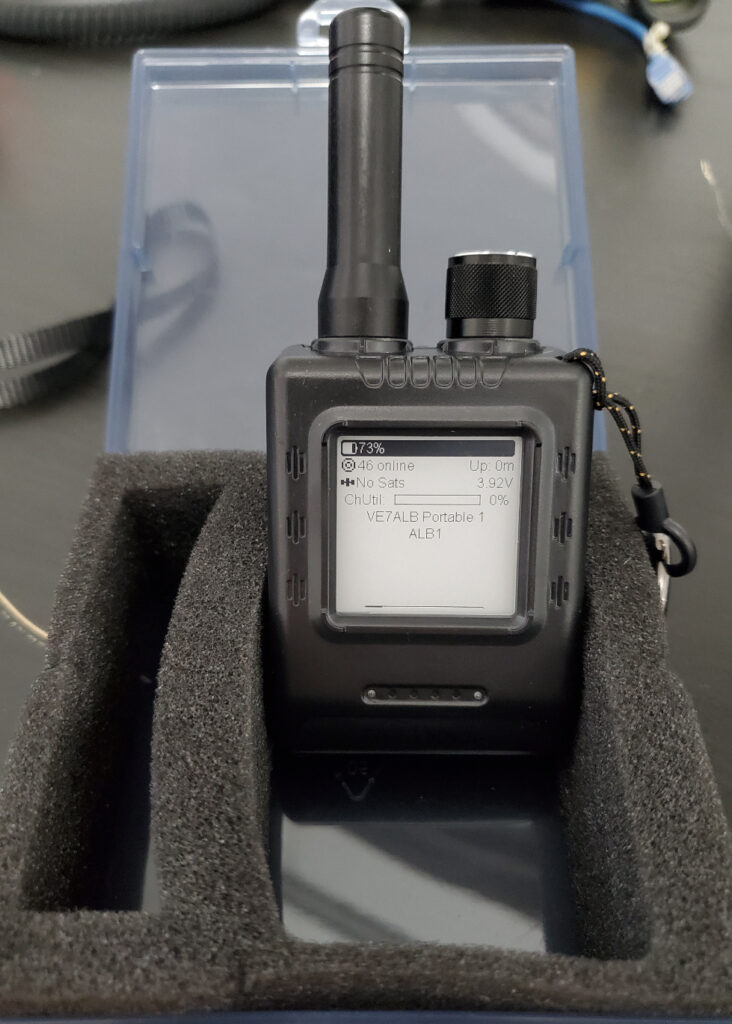
In reality though, you might end up being restricted by momentum. If you live in an area that is heavily invested in one or the other technology, then it probably makes sense to go with the flow, at least if you want to talk to anyone!
And if you happen to be in the Victoria-area, chat with me (VE7ALB) on Meshcore! Or look for my GPS tracks on Meshtastic.